Mole Control FAQ
Oregon's mole and gopher control specialists. Serving Oregon City, Portland, Lake Oswego & surrounding areas.
Call or text: (971) 282-5065
mrhillmoles@gmail.com
-
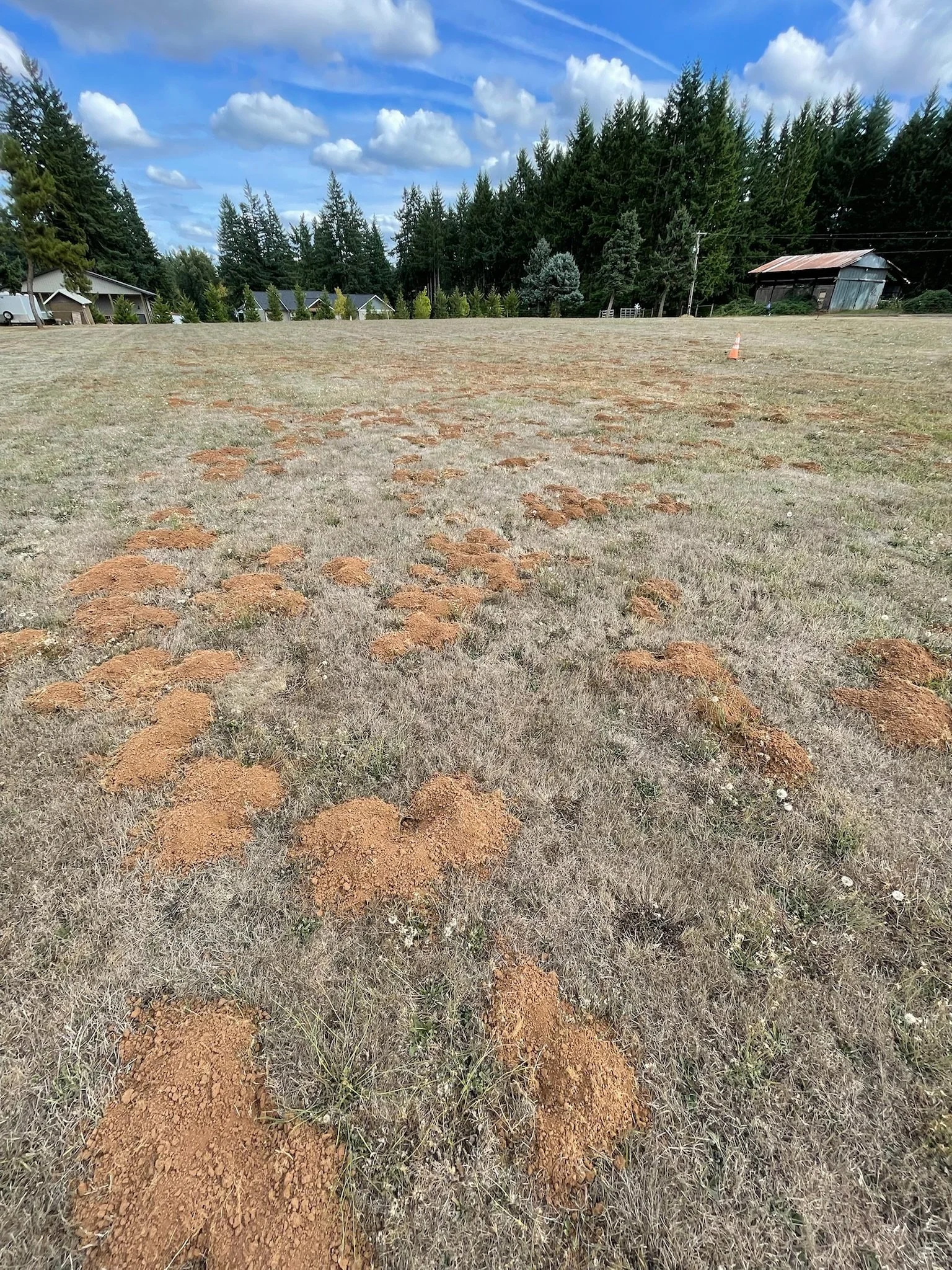
Mole damage in Oregon typically appears as raised, winding ridges running just beneath the surface of your lawn, often called "runs" or "tunnels," along with volcano-shaped mounds of loose soil pushed up from deeper digging. In the Willamette Valley, where clay soil holds moisture year-round, these tunnels stay active far longer than in drier climates — which means the damage compounds quickly if left alone. The surface ridges kill grass roots by disrupting the soil contact underneath, leaving long dead streaks across an otherwise healthy lawn. If you're in Beaverton, Tigard, or Lake Oswego and noticing soft, spongy ground or raised veins of disturbed earth, moles are almost certainly the culprit.
-
Moles are active in Oregon all twelve months of the year, which surprises many homeowners who expect a quiet season in winter. Activity peaks in spring and fall when the soil is moist and earthworms — a mole's primary food source — are most abundant and close to the surface. During summer dry spells, moles tend to dig deeper to follow moisture and worm populations, which is why surface damage may temporarily slow down even though the animals are still present. In the Willamette Valley, the combination of mild temperatures and consistent rainfall means there is really no true off-season for mole control.
-
No — moles do not hibernate, and Oregon's mild winters actually keep them more active than moles in colder parts of the country. While moles in harsher climates may slow down significantly when the ground freezes, the Willamette Valley rarely sees sustained hard freezes, so the soil stays workable and moles keep digging. Homeowners in Oregon City, West Linn, and Newberg often notice mole mounds appearing even in January and February after a stretch of rain softens the ground. This year-round activity is exactly why prompt removal matters — waiting for a "slow season" that never really comes only allows more tunneling and more damage.
-
Most residential yards in Oregon are home to just one or two moles, which often shocks homeowners given how extensive the tunnel systems look. A single mole can dig up to 18 feet of new tunnel per hour and may have a network spanning hundreds of feet, so one animal can devastate a lawn that looks like it must have dozens of them. Occasionally, adjacent properties share territory along a fence line or creek corridor, and you may deal with two or three animals moving through the same area over time. The good news is that the per-catch model used by Mr. Hill means you only pay for what's actually removed — so if it turns out to be just one mole, that's all you're charged for.
-
The clearest way to tell moles and gophers apart is by the shape of the soil mounds they leave behind. Mole mounds are roughly circular and symmetrical, like a small volcano, and are pushed straight up from a vertical shaft. Gopher mounds are crescent- or horseshoe-shaped and tend to be larger and flatter, with the dirt fanned out to one side of the plugged hole. Moles also leave surface ridges — the winding raised tunnels just under the grass — while gophers work deeper and typically don't create that kind of surface trail. If you're not sure which pest you're dealing with, a quick photo sent to Cobi at mrhillmoles@gmail.com can get you a confident answer before any work begins.
-
Sonic repellers, vibration stakes, and ultrasonic devices consistently fail to provide meaningful, lasting results against moles — and Oregon's soil conditions make them even less effective. The dense, clay-heavy soil in the Willamette Valley absorbs vibration quickly, so the devices' range is far more limited than what the packaging suggests. Moles are also remarkably adaptable; many simply learn to tunnel around the zone of disturbance or return within days once they sense the earthworms are still there. Homeowners in Portland, Salem, and Hillsboro who come to Mr. Hill have often already spent money on repellers and found the mole activity continued uninterrupted. Professional trapping is the only method with a consistent track record.
-
Poison-based products marketed for moles — including bait "worms" containing bromethalin or strychnine — have a poor success rate because moles are insectivores that primarily eat live earthworms and grubs, and they frequently ignore or bury static bait. Gas or smoke cartridges are similarly unreliable in Oregon because the Willamette Valley's porous, interconnected tunnel systems allow gas to dissipate before reaching the animal. Beyond effectiveness, these methods carry real risks: they can harm non-target wildlife, pets, and soil ecosystems, and some products leave residue in the ground. Mr. Hill uses only professional scissor traps and snap traps — no poisons, no gas, no repellents — so there's nothing left in your yard except a solved problem.
-
Professional mole trapping, when done correctly, is very safe for families and pets. Mr. Hill sets traps below ground level, inside active tunnel runs, where children and pets cannot access them during normal outdoor activity. The traps are not baited with any chemical attractants, and there are no poisons or toxins introduced to your lawn at any point. Every trap is clearly marked and checked weekly, and you'll receive photo updates so you always know exactly what's been placed and where. Families in Lake Oswego, West Linn, and Happy Valley regularly use Mr. Hill's service in yards where children play and dogs roam freely.
-
Most residential mole situations in Oregon are resolved within two to four weeks, though the timeline depends on how established the tunnel network is and how many animals are present. The process starts with a $200 setup visit, during which Cobi reads the tunnel system, identifies active runs, and installs the traps. Traps are then checked weekly, and most catches happen within the first ten to fourteen days. — a guarantee that reflects Mr. Hill's confidence in his method. Larger properties or yards with long-standing infestations, such as acreage in Yamhill County or Wilsonville, may require an additional round of trapping.
-
Mr. Hill's pricing is straightforward and transparent. There is a one-time $200 setup and trap-installation fee, followed by a $35 per-mole charge — you only pay that $35 when an animal is actually caught. There are no hidden monthly fees for one-time service. For homeowners who want ongoing protection, monthly maintenance plans start at $79 per month. Compared to repeat purchases of repellers, DIY bait, and lawn repair costs, professional trapping with Mr. Hill is often the more economical option once you factor in results.
-
Moles that have been trapped are gone permanently, but new moles from neighboring properties can move into the vacated tunnels and territory over time. Oregon's mole population is robust across the Willamette Valley, and an attractive yard with rich, worm-filled soil will always be a potential destination for a new animal. That's why many Mr. Hill customers in Portland, Tualatin, and Clackamas opt for the monthly maintenance plan, which provides regular trap checks and catches any newcomers before they establish a new tunnel network. Think of it like lawn care — one treatment solves today's problem, and ongoing service keeps it from coming back.
-
DIY mole trapping is legal in Oregon and technically possible, but it has a steep learning curve that leaves most homeowners frustrated. Success depends heavily on correctly identifying active tunnel runs versus abandoned ones, setting the trap at the precise depth and angle, and checking it frequently enough to be effective. Most hardware store traps are also lower quality than the professional-grade scissor and snap traps Cobi uses, which increases the chance of missed catches. Many homeowners in Oregon City and Beaverton try DIY trapping for a season before calling Mr. Hill, and find that the per-catch professional pricing ends up being less expensive than repeated failed attempts plus ongoing lawn damage. The guarantee also takes the risk out of going professional.
-
Moles are insectivores that feed almost exclusively on earthworms, grubs, and other soil invertebrates — they have no interest in plants, vegetables, or people. They do not bite unless directly handled and are not a public health threat the way rodents can be. The danger moles pose is entirely to your property: their tunneling kills grass roots, creates tripping hazards, and can destabilize garden beds and landscaping. In Sellwood, McMinnville, and other areas with established gardens, mole tunnels can also disrupt the root systems of ornamental plantings and vegetable beds. So while moles are harmless to your family, they are genuinely destructive to the landscape you've invested in.
-
Oregon — particularly the Willamette Valley — has nearly perfect conditions for moles: mild temperatures, consistent rainfall, and rich, loamy to clay-heavy soil that's easy to tunnel through and loaded with earthworms. The same agricultural and gardening culture that makes Oregon's landscapes so lush also produces the well-fertilized, irrigated yards that moles love most. Urban and suburban expansion from Portland into communities like Tigard, Wilsonville, and Newberg has also pushed development into former agricultural land, displacing moles from fields and into residential lawns. Add in the lack of a hard winter freeze that would slow activity, and it's no surprise that Oregon homeowners consistently rank among the most affected in the Pacific Northwest.
-
The most important questions to ask any mole control company are: what method do they use, and how do they charge? Companies relying on repellers, gas, or poisons are selling you methods that don't reliably work — a professional should be using traps, full stop. On pricing, per-catch models are far more aligned with your interests than flat monthly fees that continue regardless of results. You should also ask whether they offer a guarantee: Mr. Hill refunds the setup fee if no mole is caught in the first 14 days, which is a meaningful commitment. Finally, look for someone who knows Oregon soil conditions and local mole behavior — a specialist serving Portland, Oregon City, Lake Oswego, and the Willamette Valley will outperform a national franchise every time.
Oregon's Trusted Mole Control Specialists
If moles are tearing up your lawn in Portland, Oregon City, Lake Oswego, West Linn, Beaverton, or anywhere in the Willamette Valley, Mr. Hill is ready to help. With professional trapping, a per-catch pricing model, and a 14-day guarantee, there's no risk in making the call. CALL 971-282-5065